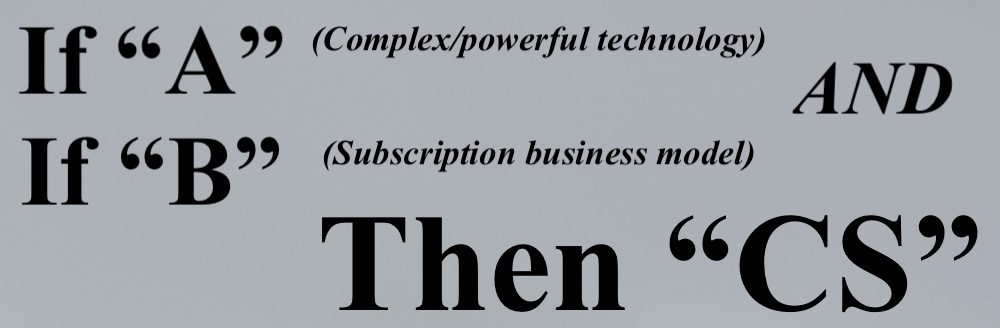

The Logic of Customer Success rests on two basic realities of the modern technology industry: The requirement for user learning, and the change brought by the new profits-realization model.
 One: Every powerful/complex technology requires that the user make an investment in learning in order to obtain the full productivity/profitability benefits from their purchase. While excellence in UI design, help screens, and/or embedded AI resources can help reduce the needed learning to some degree, they will never completely remove it. Therefore the manufacturer must provide various forms of assistance or risk losing the customer to the competition who does answer that need. Addressing this reality throughout your company and process is not an option. The burden of being successful with the technology cannot be safely left to the customers. If you don’t attend to it, your competitors will.
 Two: With the advent of the subscription business model, the vendor necessarily must gain their profit incrementally over time from income streams. This fact fundamentally changes the definition of the product, with profound effects throughout your organization and process. It’s not about the technology anymore, it’s what that technology can do for the customer that is being sold — and it has to be successfully delivered over time else no profit is possible for either customer or company. The necessary result is Product As A Relationship, and that product requires a Relationship Manager: the Customer Success team.
This Means That:

 You can’t play “take the money and run” anymore. You can’t afford bad-fit customers. You aren’t selling whizzbangs or shiny things, you are selling what they can do for the customer. If you don’t deliver, if the customer leaves before you recoup the acquisition cost, you have a dead loss. Too many of those, and you are a defunct vendor.
 You have to know everything about your customers that pertains to the continuance of the profitability/productivity relationship. The most important activity for the continuing prosperity of the company is the renewal and expansion sales. And it needs to be run with even more rigor, science and discipline than the original sale.
Everybody in your organization has to know how they necessarily contribute to relationship continuation — and they’d better be able to prove that connection if they want to keep their jobs.
Somebody in your organization has to be responsible and authentically accountable for the profitable management of the customer base, knowing and effectively using the in-depth knowledge about the customers and their desires/needs to produce the results. (I call those somebodies Customer Success. You may call them something else, but you’d better have them fully empowered to carry out their role.)
Therefore:
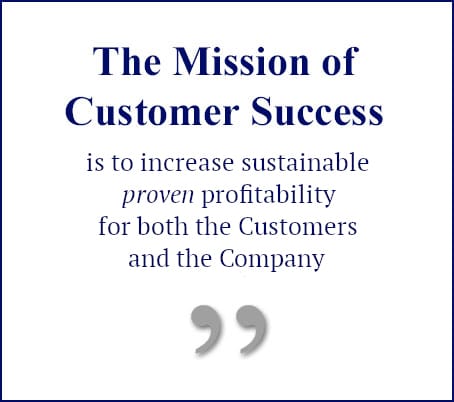
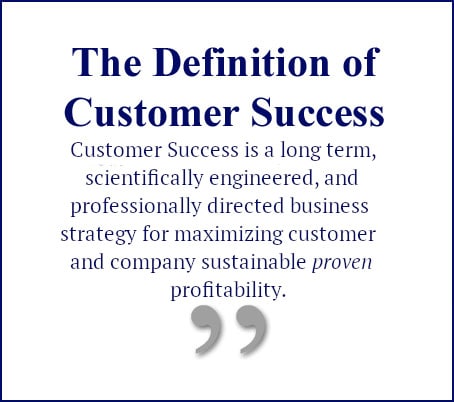
 Customer Success is a scientifically designed and professionally managed long-term business strategy for maximizing customer and company sustainable proven profitability. Everything you do needs to tie directly back to that definition. If it doesn’t, you lose.