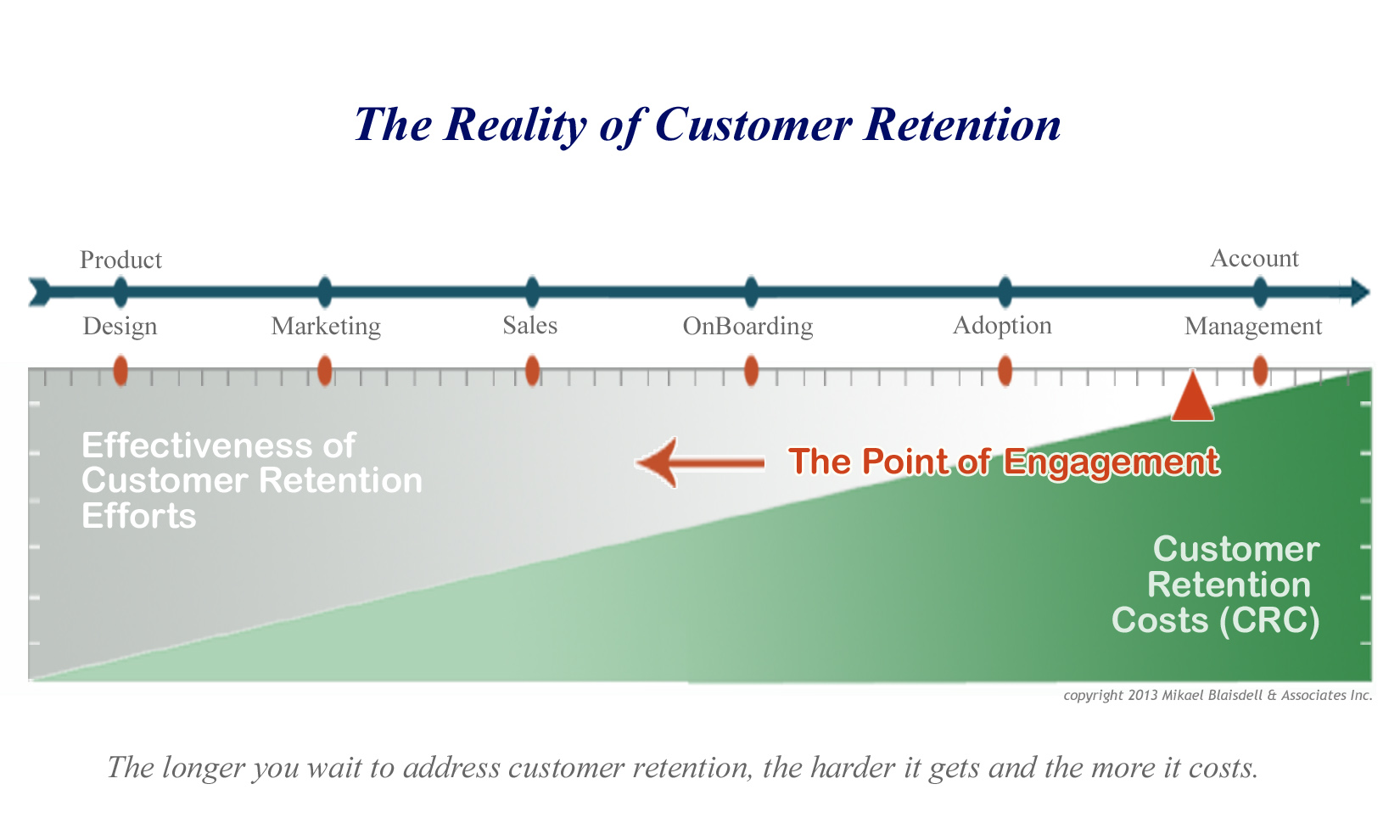
The Reality of Customer Retention graphic was one I created in the process of working with a client some years ago as they began the process of creating a new Customer Success group. If you are a company that has a complex/powerful product that you are selling on a subscription or other income stream-based strategy, then you must address the issue of customer retention at some point in your operation. It’s not an option; you are going to address it — or go out of business. What is up to you to determine is when you are going to address customer retention, and where the Point Of Engagement will be. Here are the possibilities:
Retention and Product Design.
 There is no sustainable competitive advantage in an application’s functions and features set. Anything in your product can be added by your competitors to theirs. Quality design, however, can indeed be a competitive advantage if you can take the time to produce it. The challenge in addressing retention at the Product Design phase is twofold: you often don’t have a lot of data about your customers and market, and your design budget may be limited as you haven’t generated any income from Sales at this point. The other side of this argument is that investing money here means that you’ll spend less of it over the product’s lifetime.
Retention and Marketing
Attracting the wrong kind of prospects just sets you up for later failure. Customer Success is the group that is most likely to have the data about what makes a Tier-01 level customer relationship, and how to talk to this level of customer. CS needs therefore to work very closely with Marketing to focus the message on attracting more prospective high-value customers.
Retention and Sales
 Closing the wrong kind of customers accelerates the chances for failure. This is why I recommend that the senior Customer Success executive have veto power over the sales pipeline, based on retention data from the CS team. Hubspot had an admitted churn problem some time ago. The VP of Sales thought at first that it was due to bad onboarding, as we’ll discuss next, but it turned out that his assumption was wrong. The churn generator was from selling to the wrong customers. The Sales team could be grouped into 4 segments: Those whose deals almost never churned, those whose deals sometimes churned, those whose deals were evenly split between remaining and churning, and the last group of those whose deals mostly churned. The remedy that the VP put in play was to change the sales compensation plan to reward closing deals with the highest likelihood of resulting in long-term customer relationships. Six months later, the churn problem was gone without losing any of members of the Sales team.
Retention and Onboarding
A working group from a large SaaS CRM maker was analyzing their churn data, and suspected (as in the Hubspot example) that there was a correlation between who had done the implementation and the likelihood of the account churning. There were three kinds of implementation sources: the customers’ own IT team, the vendor’s onboarding group, and third-party consultants. The analysis group discovered that retention was definitely impacted by the quality of the onboarding. Their data showed that if the vendor’s team, or a 3rd party specialist, did the onboarding, the chances for retention were increased by well over 50%. While there were few surprises in the finding, what made the difference was having the actual data to prove the point. There are several firms listed on the Consultant’s Registry that specialize in optimizing onboarding programs. (Look at #16 on the Services Catalog list.) Engaging one of them to do a review of your operation is almost certainly a good use of money.
Retention and Adoption
 If the customer isn’t using the most valuable features, they are less likely to want to remain with in the relationship. But do you know which of the features in your application are the most vital ones? That’s one key question, The second question is: Are you able to monitor what features the customers are actually using and when? This vital data enables the Customer Success team to plot the ideal product adoption curve for customer and then to intervene in customer relationships that are lagging in advancing up the curve or even regressing into being At-Risk.
Retention and Account Management
 This group includes the Success, Support, farmer sales, and renewal teams, etc. Companies that wait until this point to take measures to ensure customer retention are going to spend far more and be far less effective in addressing churn risks. There are too many stories making the rounds about finding out that a customer was leaving in the course of making a call about renewal. While Support data, in some cases, can be indicative of an at-risk customer relationship, a far better indicator is found in the product usage data and in the conversational records of the Success team.
The Bottom Line of Customer Retention
The essential point that the graphic was intended to illustrate is that the later the Point Of Engagement as regards customer retention, the more you’ll spend and the less effective you are likely to be.
If you are getting resistance to your Customer Success program, gather the supporting data for your company and use the graphic as you make your case to your C-Suite about where your team’s Point Of engagement should be.