
Ever since 2012, when the global proliferation of Customer Success groups really began to skyrocket, the profession has had an identity problem. What is Customer Success? In the Buddhist tradition, there is a parable that offers insight. Several blind men are called in to determine what an elephant is by touching it. “It’s like a fan” said one man, touching the ear. “No, it’s a plough share,” said another, touching a tusk. “It’s like a broom,” insisted one man, touching the end of the tail. John Godfrey Saxe’s poem about it has an apt line: ““Though each was partly in the right, / And all were in the wrong!” Now we are entering the ai era, and doomsayers are proclaiming the end of the CS profession because most/all/many of the CSM pieces/tasks can be done faster and more economically by ai agents. Like the blind men, they mistake the pieces for the whole. What should we learn from that elephant? To determine our future, we need to look at the purpose of the role.
The Foundational Reality of Customer Success
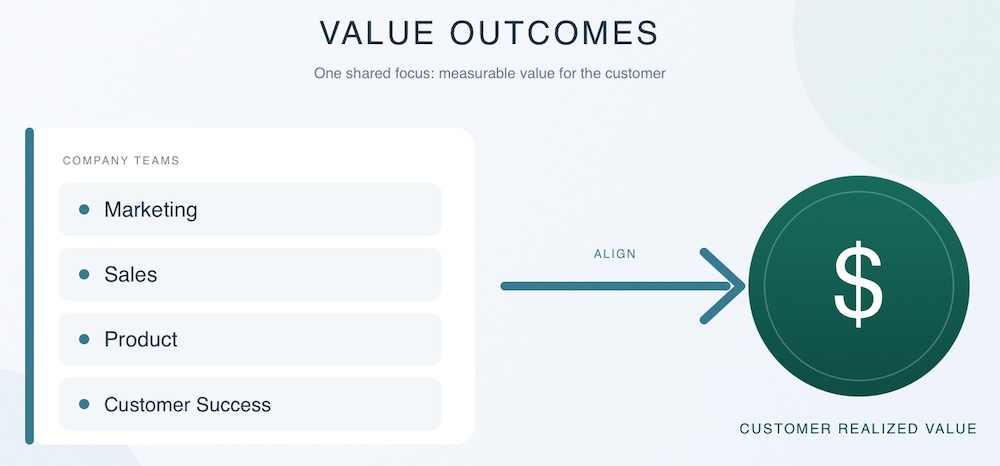
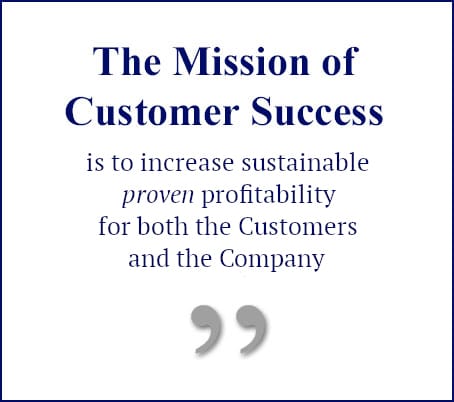
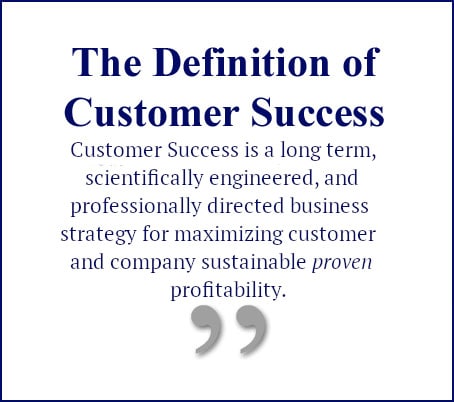
 Every complex/powerful product requires the user to make an investment in learning in order to obtain the promised increase in productivity and profitability. AI is no different. What is being sold to the customer — and bought by them — is that promised profitability increase; the technology and the training in using it are only aids to the desired value outcomes. The purpose of the Customer Success team is to increase sustainable proven profitability for both their customers and their company. The lack of common active support for that charter is the proverbial elephant in the room, and it’s time for all of us to talk seriously about it. Software companies need to stop selling technology, and start selling provable value outcomes.
The Transition to Value Outcome Operations
Marketing needs to promote promises of specific productivity and profitability gains through buying the company’s technology. Sales needs to sell those gains and show how they will be proven. Product needs to build the features into the technology that will deliver the value outcomes — while being able to track and to prove usage and results. Customer Success guides the customer throughout the journey to obtain those outcomes, and then to show how even more can be gained. At every step of the way, both provider and customer can see how actual usage necessarily ties into proven results.
 The transition process begins when all of the functional groups come together to agree on the proven value outcomes that the customer wants to buy, to construct a library that can generate menus from which the customer can select. These need to be provable so that the customer can see the results and how they were obtained. This establishes confidence, and enables more sales to be made. The bulk of a company’s profits comes from its customer base, and it’s time to begin to operate on that strategic basis.